
Going somewhere new with low vision takes an extra layer of planning. Transport, unfamiliar streets, finding the entrance, and then the question of whether the place is actually any good once you're inside. A bit of preparation is the difference between an outing you're in control of and one that happens to you.
Check here first
Look the venue up on Cane and Table. If someone's already been, most of the work is done and you can get on with the bus times.
If there's no listing yet, the rest of this is how to work it out yourself.
Plan the trip
Search for the venue's website on your phone and get the address. Google will usually let you open it straight in Maps, and from there you can plan the bus or send the location to whoever's driving.
Ring ahead
Don't be shy about calling. Ask whether they're low vision friendly, whether there's accessible parking, how to find the entrance, where the counter is.
Tell them what you need, because it's different for everyone. I have more vision than my dad, who's further along than me. What works for me doesn't necessarily work for him. The more you tell them and the more they tell you, the better the visit goes.
If they're vague or dismissive on the phone, that's information too. Consider somewhere else.
Brief your sighted guide
Does your friend know how to guide? If not, teach them, or send them our guide for sighted guides.
Have they been to the venue before? If so, good — they can help much more directly. Just remember that sighted people aren't thinking about accessibility when they go out, so they may not know the answer to things they've walked past a hundred times.
Things worth telling them to watch for: staircases and how many steps are in them, low branches and obstacles on the path, and whether the path is wide enough to walk two abreast. Guide Dogs NSW/ACT teaches taking your guide's elbow with your non-dominant hand, which leaves the dominant one free for the cane.
Make it obvious
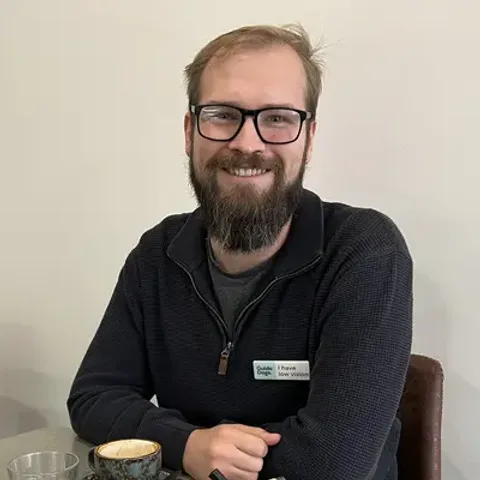
Wear something that signals low vision. I wear a badge from Guide Dogs NSW/ACT that says "I have low vision", and I take my cane almost everywhere. Even folded and unused, people see the cane and adjust. A guide dog does the same job.
Use the tactiles
Check for tactile ground indicators. You might not use a cane yet, but the tactiles marking stairs and crossings are still there for you. A cane picks them up sooner, but your feet will find them.
Tell the staff you're there
Once you're inside, say who you are. That gives them the chance to do what you asked for on the phone: showing you to a seat, putting the menu in your hands, reading it out if you don't have the tech to do it yourself.
Ask where the toilets are then, rather than when you need them.
Ordering and paying
Staff may take payment at the table. I've seen it at clubs, rarely at cafes or restaurants. Either way, remind them you have low vision and may need a hand.
Modern terminals often have no physical buttons. Never give your PIN to anyone. Ask whether there's a terminal with buttons, or pay cash. This is another thing worth asking about when you ring.
You might also have to go to the counter to order. If you're on your own, say so when you sit down so they know to come and get you.
Be patient with them
Most people don't know how to help even after you've told them. Your outing is their experience too. If you're rude, they'll dread the next low vision customer and the service gets worse, not better. If it goes well, they'll try harder next time. That's most of how this changes.
The table
Be careful when the food arrives. Dark plates on dark tables are almost invisible, and a hot plate you can't see is burnt hands. Ask ahead for contrasting crockery if that helps you.
Use the clock method. It's the quickest way for someone to tell you where things are. On a square table your position is six o'clock, the setting opposite is twelve, to your left is nine, to your right is three. Something directly in front of you is six o'clock; over to the left and closer to the middle is centre nine. It takes a little learning and then it's automatic.
Then write it up
Don't keep what you learned to yourself. Accessible parking, whether the entrance was findable, how easy it was to order, whether the staff had a clue — that's exactly what the next person needs. Find the venue and add your review.